

Baseboards,
Trim & Transitions
Done Right
The last two inches of every flooring job are what people actually see. Carpet Services Incorporated (CSI) installs every baseboard, shoe mold, reducer, threshold, and stair nosing with finish-carpenter precision — clean lines, zero gaps, no caulk left visible.
Why Baseboards, Trim &
Transitions Matter
Flooring installations live or die on their finish details. A pristine field of luxury vinyl plank flooring or freshly laid carpet flooring loses its impact the moment a homeowner notices a gap where the floor meets the wall, a mismatched threshold in a doorway, or a stair edge that was left raw. Baseboards, trim, and transitions are the punctuation marks of a flooring project — they signal to anyone who walks the room whether the job was done by a professional or patched together.
Carpet Services Incorporated (CSI) has handled finish carpentry as an integrated part of every flooring installation since our founding in Addison, IL in 1979. Carmine and Victor Molfese built the company on the principle that a flooring job isn't finished until the last piece of trim is seated, caulked where appropriate, and indistinguishable from the rest of the room's millwork. That standard hasn't changed.
Whether you're replacing floor-to-ceiling trim throughout a DuPage County home renovation or simply need a matching threshold between a new kitchen tile and an existing hallway, CSI measures, sources, cuts, and installs the right profile for the job — no subcontractors, no callbacks. Explore our installation and repair services to see the full scope of what our crews deliver.
Five Profile Types,
Five Different Problems Solved
Every floor meeting — wall, doorway, level-change, or staircase — demands a specific trim profile. Use this guide to understand which solution CSI will specify for your project.
Baseboard & Shoe Mold
Covers the wall–floor junction and the expansion gap required by floating floors. The baseboard anchors to the wall; shoe mold covers the floor edge.
T-Molding
Bridges two floors of equal height meeting in a doorway or open passage. The T-cap spans the gap without a raised edge in either direction.
Reducer Strip
A tapered ramp profile that eases foot traffic from a higher floor surface to a lower one — typically thick LVP or hardwood meeting ceramic tile.
Threshold & End Cap
Terminates a floor run at an exterior door, sliding door track, or room divider. Provides a finished, sealed edge where the floor meets a fixed vertical surface.
Stair Nosing
Caps the leading edge of stair treads where new flooring meets the stair structure. Prevents chipping, meets Illinois building code, and reduces trip hazard.
Every Profile, Every Material — Specified Right
Not every home calls for the same millwork. CSI matches trim material, profile, and finish to your floor, your room's existing millwork, and your budget.
Baseboards & Shoe Molding
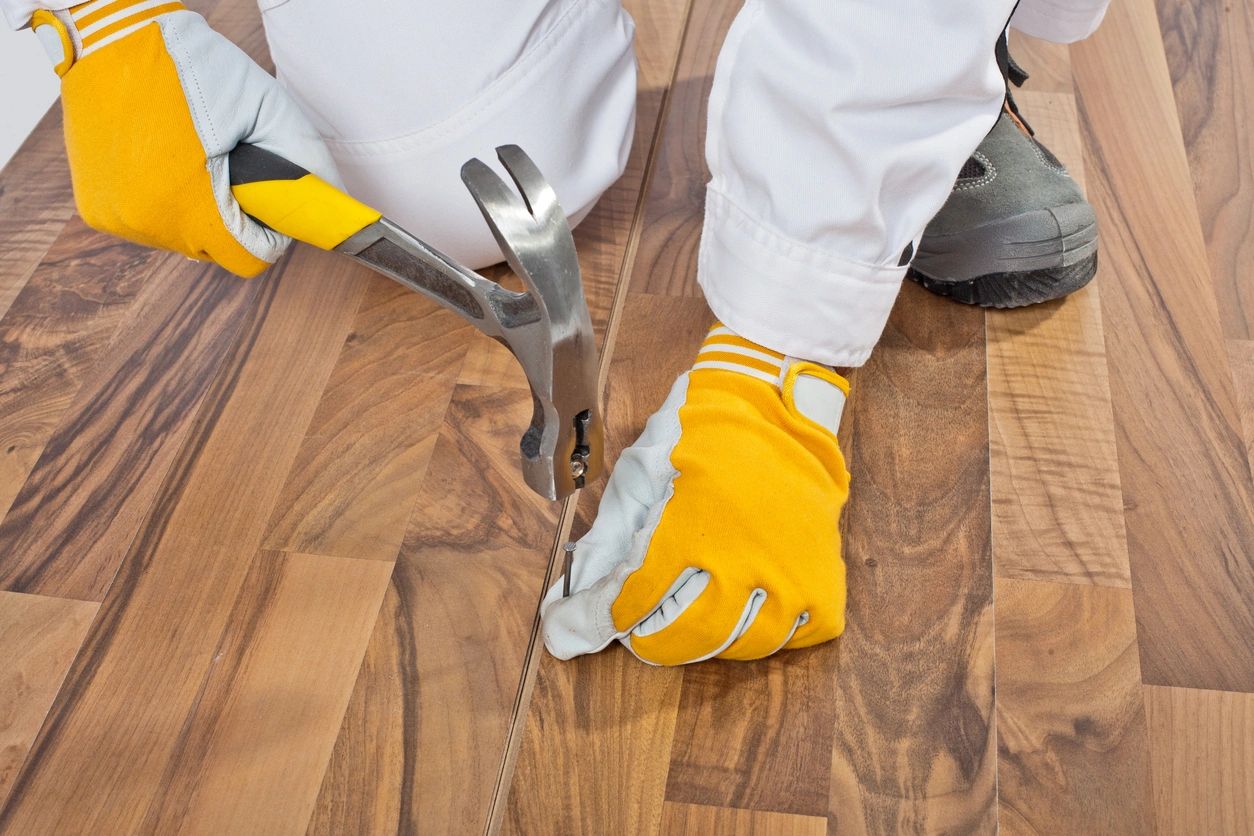
Baseboards run horizontally along the base of every wall, bridging the gap between drywall and finished floor. CSI installs baseboard in MDF (most cost-effective, paintable), solid finger-jointed pine (traditional, paintable, takes stain poorly), and solid poplar or oak (premium, stain-ready). Heights range from the standard 3⅛" ranch profile to 5⅝" colonial and tall 6" craftsman boards for rooms with high ceilings or strong architectural character.
Shoe molding — the small quarter-round or square profile that tucks between the bottom of the baseboard and the floor surface — is mandatory on any floating floor installation. It conceals the ⅛"–¼" expansion gap that floating systems require and keeps debris from migrating under the floor edge.
- Profile options: ranch (3⅛"), colonial (5⅝"), craftsman (6"), custom
- Material: MDF paint-grade, finger-jointed pine, solid poplar, solid oak
- Shoe mold: quarter-round or square shoe — matches baseboard material
- Finish: paint-ready, pre-primed, or raw stain-grade depending on material
- Fastening: blind-nailed to wall studs, never to the floor surface
- Caulk: paintable latex caulk at wall joint only — floor joint left free

Transition Strips & Thresholds
Doorways, open passages, and room dividers are where two flooring systems meet — often at different heights, different materials, and different expansion behavior. CSI measures both floor thicknesses and the gap span before specifying the correct profile. The wrong transition strip not only looks wrong; it can create a rocking hazard or allow moisture to migrate between floor systems.
Transition strips are available in coordinating finishes to most major LVP, hardwood, and tile collections. CSI sources manufacturer-matched molding wherever available so the transition reads as intentional rather than an afterthought.
- T-molding: equal-height floors meeting in a doorway or passage
- Reducer: tapered ramp where two floors differ in height by ¼"–¾"
- End cap / threshold: floor terminating at a door, slider, or fixed wall
- Carpet bar: toothed metal strip that grips and terminates carpet edge cleanly
- Material: wood-look vinyl, solid hardwood, aluminum, or stainless profiles
- Fastening: track-and-clip system or glue-down depending on subfloor type

Stair Nosing & Tread Wrapping
Stairs are the highest-wear, highest-consequence surface in any home. A poorly installed stair nose can loosen under daily foot-strike, creating a progressive trip hazard that worsens with each day. CSI's stair work covers two scenarios: overlay nosing (where new flooring overlaps the existing tread structure) and full tread wrapping (where new flooring material is cut, adhered, and nosing-capped to fully resurface the stair tread and riser).
Illinois residential building code requires a nosing projection of ¾"–1¼" on all stair treads. CSI installs code-compliant nosing profiles in materials matched to your floor — LVP-matched, hardwood, or aluminum — and uses structural adhesive plus mechanical fastening for a permanent installation.
- Overlay nosing: caps existing tread edge where new floor meets stair
- Full tread wrap: complete tread + riser resurface with matching flooring
- Code-compliant projection: ¾"–1¼" per Illinois residential code
- Material: LVP-matched vinyl, solid hardwood, aluminum edge-protector
- Fastening: structural adhesive + countersunk mechanical screw
- Bullnose finish: rounded-front profile reduces trip hazard at tread edge
The CSI Trim &
Transition Process
Every trim and transition job follows the same disciplined sequence — the same one CSI has refined since 1979.
Room Measurement & Profile Assessment
A CSI estimator measures every wall run, doorway span, and stair tread in the project scope. We document existing baseboard profiles so new trim can match or complement what's already in the home. Subfloor height differences at doorways are measured to the nearest ⅛" — the spec that determines which transition profile is correct.
Accurate Written Estimate
You receive a line-item estimate separating material and labor for each trim component — baseboard linear footage, transition strip count, stair nosing count, and any subfloor prep that affects trim heights. No "misc. trim" line items that expand after install day. Contact us for a free flooring estimate to get started.
Material Sourcing & Profile Matching
CSI sources from its standard trim inventory for common profiles and coordinates with flooring manufacturers for collection-matched transition strips. For older homes with discontinued profiles, we bring samples to the Addison showroom for a hands-on profile match consultation.
Precision Installation
Existing trim is removed cleanly without damaging drywall. New baseboard is scribed to uneven walls, mitered at corners, coped at inside joints, and blind-nailed to studs. Transition strips are installed on track systems or adhesive — never floating. Stair nosing is adhered and mechanically fastened. Every cut is made on a power miter saw for clean angles.
Post-Install Walkthrough & Punch List
A CSI supervisor walks every wall run, every doorway transition, and every stair tread with you before the job is closed. Touch-up items are completed on the spot. Paint-ready surfaces are left clean, primed, and ready for your painter.
Finish Carpentry Is Where
Most Flooring Crews Fall Short
Trim and transitions are where many flooring installers cut corners — literally and figuratively. CSI treats finish details as seriously as the flooring field itself.
Four Decades of Finish Detail
Carmine and Victor Molfese founded CSI with finish quality as a non-negotiable. Forty-five years of Chicagoland projects have sharpened every trim installer on our crew to understand that mitered corners, tight copes, and flush transitions are what homeowners remember — not the square footage count.
Same Crew, Floor to Trim
CSI never hands a trim job to a subcontractor. The same trained employee who installed your floor finishes your trim — which means they already know the expansion gap, the floor thickness, and every doorway height in the room. Continuity eliminates the gap-in-knowledge that produces mismatched profiles.
Touch Every Profile Before You Commit
Our Addison showroom stocks baseboard profiles in full lengths, transition strips in every common finish, and stair nosing samples alongside the flooring collections they're designed to match. Choosing trim in a room with natural light — not from a two-inch catalog swatch — produces better decisions every time.
One Estimate Covers Everything
CSI quotes flooring, subfloor prep, trim, transitions, and stair work as a single integrated project — not as add-ons that inflate after the crew arrives. You see the full cost before a single plank is laid, which means no budget surprises at the finish-out stage when you're most eager to be done.
Precision Craftsmanship,
Room by Room
What a Finished Room Looks Like
Watch how CSI approaches the finishing phase of a complete flooring installation — the trim selection, the corner work, the stair detail, and the final transitions that make the difference between a good floor and a finished room.
Every project you see in our portfolio includes the baseboard, trim, and transition work as an integrated phase — not a separate trade. This is the CSI standard since Addison, IL, 1979.
Request Your Estimate
The Last Two Inches —
Done Right Every Time
"We had new LVP installed throughout our main level and were dreading the trim work — three doorways with height differences, a slider threshold, and all the baseboard. CSI matched our existing colonial profile exactly and the transitions between rooms are invisible. I've had guests ask if we renovated the whole house — it was just the floors and the trim."
"The stair nosing work was what impressed me most. Our previous installer left the tread edges raw with a factory vinyl piece that started loosening within six months. CSI used structural adhesive and mechanical fastening — those treads aren't going anywhere. The profile matches the LVP in the upstairs hallway perfectly."
"We replaced carpet with engineered hardwood in three bedrooms and needed all new shoe mold throughout. CSI's estimator was the first person to explain why shoe mold is required with a floating floor — every other contractor just said they'd 'take care of it.' The crew left clean walls, tight corners, and we painted over it the next day. Exactly what we needed."
Flooring & Finish Services
Across Chicagoland
Baseboards and transitions are one part of a complete flooring project. Explore CSI's full range of flooring materials, installation services, and service areas.
Flooring Materials
Installation Services
Baseboard, Trim &
Transitions FAQ
Answers to the questions CSI hears most often during the finish-out phase of a flooring project.
Get Your Free
Trim & Transition Estimate
Tell us about your project — rooms involved, existing trim profile if known, and any doorway transitions. We'll respond within one business day with a fixed-scope quote covering every baseboard, shoe mold, and transition strip.
Contact & Location
Carpet Services Incorporated